They Say It Was Lively Here Before I Was Born: 64 Years of Mitzpe Ramon [Part 1]
The workers' camp of 1951, the cooperative of 14 young pioneers, the first child named Ramon, the hunger strike of 1974 and the sour milk: the story of the town that was almost shut down, by Inside Mitzpe.
Inside Mitzpe8 min read
Written in 2020 by Inside Mitzpe, for the 64th anniversary of the founding of Mitzpe Ramon. Translated from the Hebrew.
In 2020 the town of Mitzpe Ramon celebrated 64 years since its founding, and that is a good excuse to blow the dust off a few interesting episodes from its early years. Think you know Mitzpe's history? Come along, let's set off...
When was Mitzpe Ramon actually born?
The official documents customarily state that Mitzpe Ramon was founded in July 1956, although in practice that year marks the day the members of an agricultural cooperative settled on the land, the first to try to establish a permanent community here. In fact, their arrival was already the third chapter in the story of "Mitzpe", which was set up in 1951 as a workers' camp for the labourers paving the road to Eilat, and which later served as housing for the miners who worked the quarries in the crater (the quarries were eventually abandoned, and recently restored, giving us "Mitzpe's Sea" and the "Ramon Colours Scenic Road").
A cooperative in Mitzpe Ramon?!
The permanent settlement, then, began with the plan of 14 young men and women to found an agricultural cooperative next to the workers' camp, within the Ramat Negev Regional Council. The late Haggai Avriel, one of the founders of Sde Boker and the head of that group, recalled:
"I stood on the mountain, a light breeze blew through my hair and my clothes, and the vast expanses of the desert filled my eyes. A new dream began to take shape in my mind: here a new community will rise, unlike any founded before it. In this community people will make their living from the desert... Days of trying to persuade more friends to join the dream. At times it seemed hopeless, but when Ben-Gurion lent his support to my dream, it seemed the dream would come true after all."
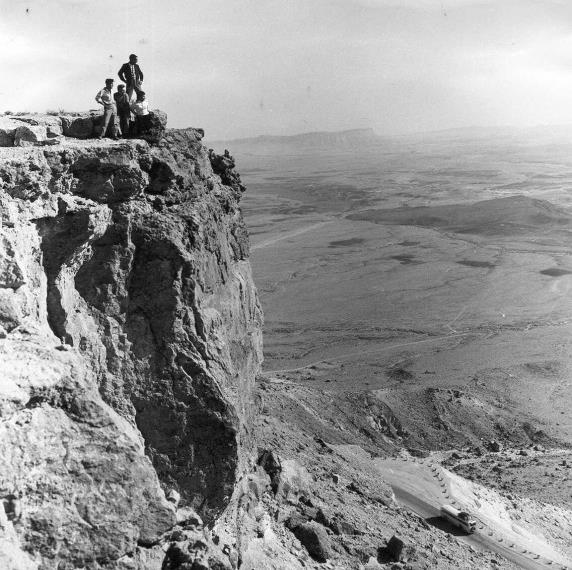
The first child: and his name in Israel shall be called...
Like many good stories, this one too began hard, very hard. The cooperative set itself the goal of building a permanent community that would live off quarrying gypsum and clay, processing and selling the minerals, and farming. But this form of settlement lasted only about a year before the agricultural association was dissolved. Just before it broke up, the first child was born in Mitzpe, and unsurprisingly he was given the name that carried an obligation: Ramon. David Ben-Gurion and his wife Paula came to visit the isolated settlement, and David said to Paula: "Paula, I can't believe my eyes. Where women hang nappies on a washing line, there is a settlement."
After the association was dissolved, the residents who remained (about 100 families) pinned their hopes on help from the Ministry of Defence, believing that the army bases planned for the area would keep Mitzpe alive. This time it was the Six-Day War that reshuffled the cards: in its wake the spotlight (and the budgets) turned to developing the new territories added to the young state, rather than the Negev. And as if those troubles were not enough, one of the main reasons for settling here in the first place, the main road to Eilat, became irrelevant when the Arava road was paved, a far more convenient and significantly shorter route. In those days the Egged bus company "went one better" and decided to cancel the Mitzpe Ramon–Eilat line. The town was dying.
Hunger strike, protests and shuttered businesses
The press clippings of summer 1974 tell of the peak of a severe crisis. So severe that the few residents who remained (about 1,500) decided on a drastic step and declared a hunger strike. The move succeeded in drawing attention, and almost every newspaper published at the time covered the dramatic step and gave a platform to the hardships of the town and its people. The newspaper Al HaMishmar reported: "If a resident of Mitzpe Ramon needs any medication, or has to undergo a simple blood test, he must travel 200 kilometres (!) to Beersheba and back, with the bus winding through bypass roads and every remote settlement between Mitzpe Ramon and Beersheba."
Another paper wrote that "the women of Mitzpe Ramon protested that the dairy products arrive spoiled. The residents claim that the milk delivery, which leaves Beersheba at three in the morning, reaches them only at noon, by which time the milk is sour and the dairy products have gone off."
To live or to cease
The dire situation led the government ministries to re-examine Mitzpe and how it had been established, and the newspaper Davar wrote: "Some 18 years after settlement began in Mitzpe Ramon, the Ministry of the Interior has reached the conclusion that what this place lacks is planning" (hmm... after 18 years, good of you to remember). Some went further and argued that the crisis proved the town had no right to exist. This is what Haaretz wrote: "An abandoned town asks for an end: everything is frozen in Mitzpe Ramon, a forsaken town in the heart of the desert, its residents fed up with promises... They demand that the government decide: what is to become of Mitzpe Ramon, to live or to cease?" One resident said: "The town is dying and nobody in the government cares... All the proposals and recommendations stayed on paper and the town keeps freezing. [...] I asked the manager at Tnuva to find a way to send the milk earlier and not spoiled. The answer was: say thank you that you get the produce at all, especially now that one of our drivers is on reserve duty."
The first wave of new immigrants reached Mitzpe in 1962 and took part in the hunger strike. Note the rare words of one of those immigrant women: "Let them swap us for another town. Where is the government of Israel? Let them come here and see how we live." Another resident added: "Since the Six-Day War the border has run away from Mitzpe Ramon... The way the bus runs away from the station, that is how hope runs away from Mitzpe Ramon."
And a good thing nobody listened to Dunevitz
The sharpest expression of the deep crisis I found in the words of the late Haaretz journalist Natan Dunevitz: "A brave government, one that also knows how to save the public's money, would most likely decide to close Mitzpe Ramon. [...] Mitzpe Ramon has no right to exist, and there is no justification for planting false hopes in its residents... Promises were always handed out wholesale, and in most cases with nothing behind them. That is how illusions are born, and from them grow disappointment and bitterness. Why delude these good people?"
As you have surely noticed, we are still here. Following the hunger strike the government decided on a series of measures for the accelerated development of the town. One of the optimists (perhaps a "prophet") wrote at the time that "Mitzpe Ramon could serve as an extraordinary magnet, both for settlers and for tourists. It has a breathtaking landscape and surroundings free of ecological troubles."
No milk is to be taken for granted
In its 64 years Mitzpe has known many ups and downs, more than this page can hold. But today it seems that "Mitzpe", a magical and singular place, has found its way (which is not to say there are no problems left to solve). First of all, let us note that nowadays Mitzpe offers its residents milk of every kind, and usually it is not even spoiled. Beyond that, the number of residents and visitors has grown steadily, and with it the need for service providers, businesses and housing. The roads have improved, the distances have shrunk, and Mitzpe Ramon and the crater now hold an important place on the local and international tourism map; even an international airport and two border crossings are an hour and a half's drive away.
Proud of the past, moved by the present, looking to the future
The unique historical and human story of Mitzpe still needs to be told. First of all for its residents and the people of the Negev, and second for the citizens of Israel, who in recent years come to visit more and more, yet do not really know the special community and the moving story of this place. The founders and those who followed them, some of whom are still here, stood firm against many challenges. Even now, the maddening desert, together with the distance and civic and social challenges, makes life here easy for no one. But Mitzpe Ramon, which in 1974 was nearly "closed", can today serve as a worthy example, in Israel and beyond, of a place where work, modernity and technology are balanced with community, ecological and social values.
Want to hear more stories about the past and present of Mitzpe Ramon? About its people and their work? About enterprise, workshops and art? Write to us on Facebook or by e-mail at insidemitzpe@gmail.com.
My thanks to the Communities Archive of the Ben-Gurion Research Institute for the Study of Israel and Zionism for making the material available. You are welcome to browse the archive.